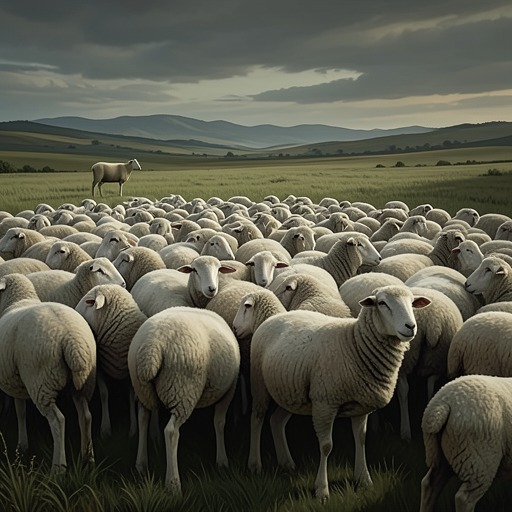
The Flock and Leaving It
Three Bags FullThe Flock and Leaving It names a central question in the sheep’s effort to understand both their own society and the humans around them: what does it mean to belong, and when does departure become betrayal? The rule that no sheep may leave the flock is not fixed in a single meaning. It can express care, fear, social order, or an oppressive demand to stay still; its later qualification, that a sheep may leave if it returns, makes room for attachment without treating separation as permanent. The sheep’s changing interpretations turn flocking from a simple instinct into a way of thinking about loyalty, isolation, and choice.
Belonging and the Human Herd
At first, the flock understands itself through collective habits and shared needs. George’s death leaves the sheep without their shepherd, and his body lies in the grass beside the hay barn, apart from the meeting the sheep hold near the cliff. Miss Maple argues that the flock owes George a search for the human responsible: he had sought the culprit when a fierce dog took one of their lambs, and he was their shepherd. Her reasoning makes belonging reciprocal. The sheep are not merely dependants who receive care; they can remember what George did and decide what they owe him in return.
Miss Maple extends this social understanding to humans after hearing the idea that humans are herd animals. She observes that people live together in the village and come together to look at the spade, as sheep gather in a flock. Yet the comparison makes George’s position more puzzling, not less. Sir Ritchfield supplies the missing thought: George left the flock. Maple reasons that he must have left the human herd, or perhaps been driven away from it; he was often angry with the people in the village. The sheep struggle to imagine their shepherd separated from a community, and their horror at the possibility shows how strongly they associate belonging with safety. Their reference to the Devil’s hounds frames his fate as a punishment he did not deserve, even as they try to make sense of why someone would live apart.
Separation, Strategy, and Return
The rule against departure first sounds absolute. When Miss Maple plans to reach the village with a small party and listen to Beth and the red woman, Cloud objects that no sheep may leave the flock. Maple revises the terms rather than abandoning the rule: a single sheep going off alone would be leaving, but several sheep together could count as a little flock of their own. The distinction is practical and ethical at once. She admits that going alone had been wrong and that a sheep could not bear it; this time, companionship makes a risky excursion possible. She rejects the idea that the whole flock should go, since a crowd in Beth’s garden would attract suspicion. Belonging is thus flexible enough to permit a purposeful group to leave without pretending that isolation and collective action are the same.
The sheep’s argument also reveals how their social rules shape what they can do. They do not simply choose between obedience and rebellion: Maple finds a form of action that preserves the flock by making a smaller flock. The group includes Othello, Zora, Lane, Cloud, and Mopple the Whale, chosen for bravery, practicality, companionship, and memory. The mission’s very composition makes the principle concrete. Leaving becomes possible when the sheep remain answerable to one another rather than sending a lone member into danger.
Melmoth’s absence tests the rule in a more painful way. When he goes away, the meadow seems empty to the sheep, and Sir Ritchfield reassures them that he has gone for a stroll and will return. Ritchfield repeats the rule with a new exception: no sheep may leave unless that sheep comes back again. The addition does not erase the anxiety of absence. It gives the flock a way to hope for return while acknowledging that departure can happen. Maple then understands George’s estrangement through another flock comparison: he discovered that his was the wrong flock because it had killed McCarthy. People who could not be identified by scent were, in the sheep’s terms, wolves in sheep’s clothing. George’s departure from the human group becomes connected to the exposure of its violence, and to what Maple understands as justice when a secret gets out.
Herding, Power, and the Cost of Staying
The concept also turns on who gets to direct a flock. George explains that sheep can be herded because they stay together and can be understood as a group; a single sheep is unpredictable, and sometimes being alone is an advantage. His observation complicates the comforting idea that togetherness is always protection. The flock’s cohesion makes it legible and governable, while an individual outside it may escape that predictability. The distinction also matters to George and Ham’s effort to find evidence: George proposes that, as outsiders, they should use their position rather than assume that isolation leaves them powerless.
The contrast between care and control becomes stark when Gabriel takes charge. The sheep interpret him as a lead ram who wants his flock to stay in one place and keep still. But when three members of that human group go off, Gabriel pursues them; in Maple’s judgment, he cannot keep the flock together. His treatment of the pasture sharpens the contrast. He uses George’s scythe to cut grass, making a human act of grazing into destruction: the grass lies flattened, and the sheep watch a tool they know but do not understand turn into an instrument of damage. Remaining under a leader, then, does not guarantee that a flock is cared for. The sheep’s suspicion that Gabriel is watching the shepherd’s caravan because something important must not get out links enforced cohesion to the control of knowledge as well as movement.
Choosing a Flock
George’s will gives the question of belonging practical consequences. His fortune is left to the sheep so that they can go to Europe as promised, but they need an authorized representative to accompany them as their shepherd. The will requires daily reading aloud, forbids selling or slaughtering the sheep, and makes a dense fleece the primary breeding concern; a third party is to check that its conditions are met. The arrangement protects the flock while also placing its future within a legal structure administered by humans. A representative is necessary, but the sheep’s assent cannot be presumed from the fact that someone wants the job.
When Gabriel stands beside the lawyer, the people of Glennkill fall silent, as if a lead ram had already taken possession of the decision. Rebecca then offers to serve. Othello steps forward, looks at Gabriel, and trots to Rebecca; one after another, the sheep cluster around her. Their movement makes their preference visible without words. It is a consequential choice of shepherd, not simply another instance of being gathered by a leader. The flock accepts a relationship that can carry it beyond its familiar pasture because it has acted together in choosing who will guide it.
The rule’s final shape is therefore neither an order never to separate nor permission to abandon one another. George’s alienation shows how a flock can become morally wrong; Melmoth’s absence makes return the condition of hope; Maple’s small traveling party shows that a new flock can form through shared purpose; and the sheep’s turn toward Rebecca shows collective judgment in action. Across these episodes, belonging is measured less by physical proximity than by care, recognition, and the possibility of return. The sheep remain a flock not because no member can move, but because their bonds can survive movement and help them decide whom to follow.